
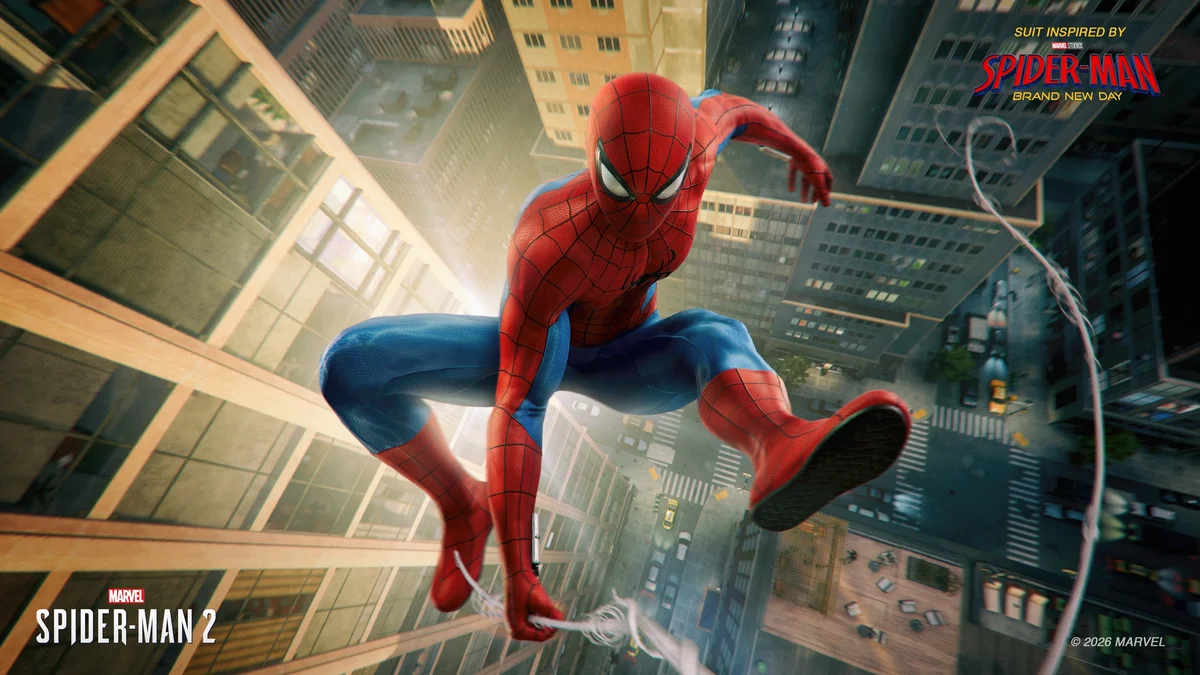
Spider-Man has always changed costumes. That variety has become one of the most consistently exploited pleasures of his video game adaptations. The latest PC update for Marvel's Spider-Man 2 takes the idea slightly further, though: Peter Parker is no longer only revisiting his own history, but borrowing the clothes of other contemporary Marvel productions.
Since July 28, Insomniac's game has included the Fresh Start Suit inspired by Spider-Man: Brand New Day and the MARVEL Tōkon: Fighting Souls Suit. On August 11, Nixxes further adjusted Fresh Start based on player feedback.
The costume becomes a bridge between works
Brand New Day offers the clearest example. A design associated with cinema enters an already established video game without requiring a full adaptation or even new narrative content. The costume alone creates the connection.
That kind of circulation is especially effective for Spider-Man, a character whose visual identity combines an extremely stable silhouette with countless variations. Materials, eye shapes, patterns and proportions can all change while the hero remains instantly recognizable.
Insomniac's game therefore operates almost like a gallery in which multiple industrial interpretations of the same character can coexist. Peter remains the Peter of Marvel's Spider-Man 2, but his appearance can temporarily belong to another production.
Tōkon makes the exchange even clearer
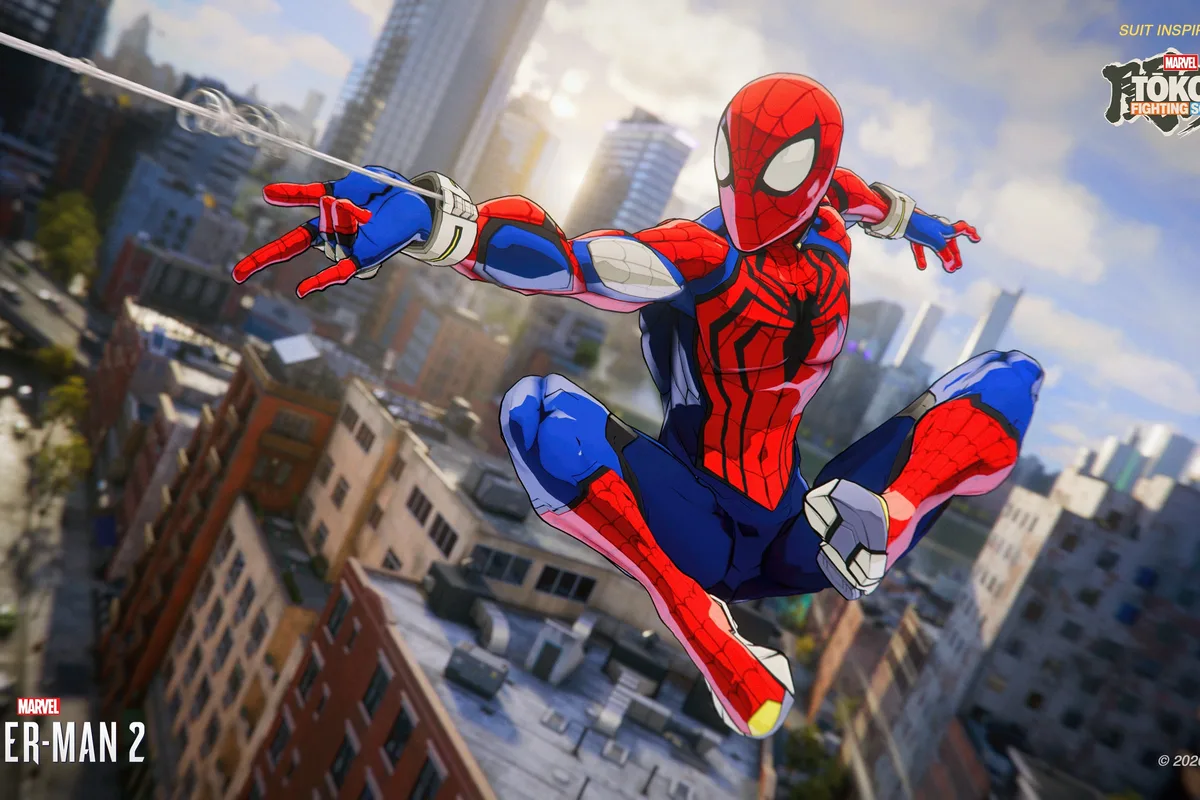
The MARVEL Tōkon: Fighting Souls Suit makes this process even more interesting because the movement now takes place between two video games that do not share the same artistic direction.
Tōkon's aesthetic is considerably more graphic and stylized. Placed inside Insomniac's comparatively realistic New York, it creates an intentional contrast. That difference highlights how Spider-Man is not merely a character used by multiple studios, but a recognizable silhouette each team can redesign according to its own visual language.
An increasingly cross-media Spider-Man
These outfits obviously do not change the story of Marvel's Spider-Man 2. They do not transform its combat or traversal either. Their function is cultural before it is mechanical: recognize another version of the character, then allow the player to inhabit it.
The approach works particularly well because Insomniac's game already treats its wardrobe as an archive of the wider franchise. Adding current references to Brand New Day and Tōkon simply means extending that archive almost in real time.
The result says something about Spider-Man's current place in popular culture. The character no longer moves neatly from comics to cinema and then from cinema to games. His different incarnations now respond to one another simultaneously. A costume can originate in one work, appear in another, be reinterpreted by a third studio and eventually return in yet another form.
Two skins do not amount to an industrial revolution. They do, however, provide a compact demonstration of how Marvel's most recognizable characters now circulate: less as isolated adaptations and more as parallel versions capable of constantly referencing one another.